
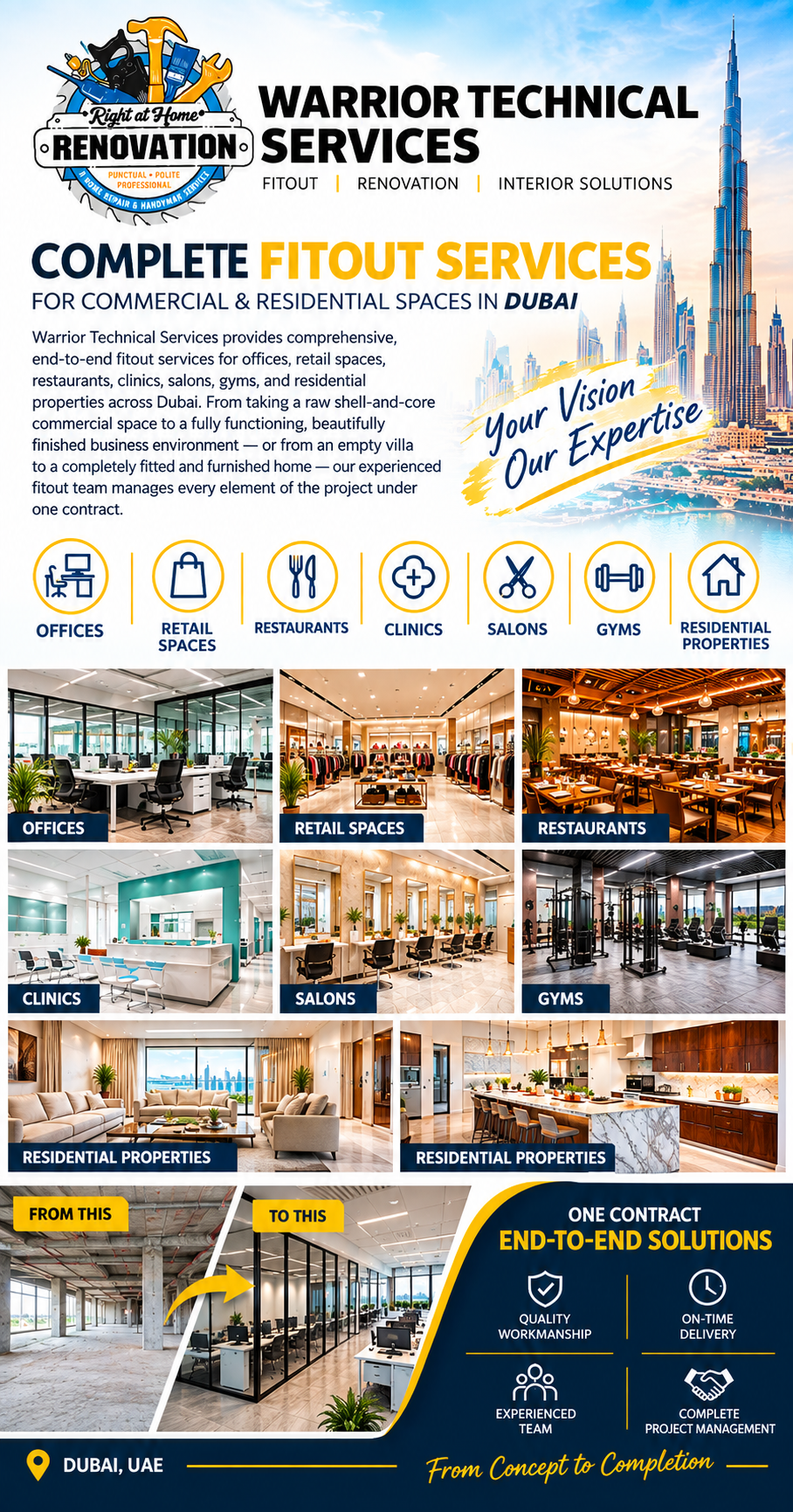
Dubai’s skyline may be defined by its iconic towers and sprawling developments, but it is what happens inside those structures that truly drives the city’s commercial and residential appeal. Fit-out services—the specialized process of transforming an empty shell into a functional, aesthetically refined space—have become a cornerstone of Dubai’s construction and real estate ecosystem. From corporate offices in the Dubai International Financial Centre to luxury boutiques in City Walk and high-end villas on Palm Jumeirah, fit-out companies are the invisible force bringing the city’s interiors to life.
Understanding Fit-Out Services
“Fit-out” refers to the process of making an interior space ready for occupation. Unlike base building construction, which delivers the core and shell of a structure, fit-out encompasses everything from interior design and partitioning to mechanical, electrical, and plumbing (MEP) systems, joinery, finishes, and furnishings. In Dubai, this process is heavily regulated and requires coordination across multiple authorities, making the role of experienced fit-out contractors indispensable.
The scope of fit-out services typically includes space planning, architectural and MEP drawings, civil works, partition systems, ceilings and flooring, custom joinery, lighting and HVAC installation, fire and life safety systems, and final finishing touches such as wall cladding, decorative elements, and furniture.
The Dubai Fit-Out Market: Growth and Demand
Dubai’s fit-out market is experiencing robust growth, driven by the emirate’s expanding real estate sector and evolving workplace trends. According to data from Turner & Townsend, demand for premium office space remains strong despite broader economic uncertainties, with high-profile developments like the Dubai International Financial Centre setting new benchmarks for workplace quality.
The numbers are telling. Dubai registered over 1.38 million tenancy contracts in 2025, with aggregate value increasing 17% to AED 126.4 billion. These lease activities directly translate into fit-out demand as new tenants reconfigure spaces and existing occupiers invest in upgrades. In the luxury residential segment, demand from ultra-high-net-worth individuals remains particularly strong, with one fit-out specialist, Alpha Nero, signing contracts for 34 luxury residential projects valued at over AED 70 million.
The hospitality sector also contributes significantly. Dubai’s occupied room nights reached 44.85 million in 2025, up 4%, raising wear-related refurbishment requirements and supporting recurring upgrade cycles. Average daily room rates rose to AED 579, strengthening the investment case for premium guestroom and public-area upgrades.
Key Drivers Shaping the Market
The Evolution of the Workplace. As flexible working has become entrenched, offices have transformed from daily attendance spaces into collaboration hubs. Businesses are increasingly investing in higher-quality, sustainable workspaces designed to bring people together, support collaboration, and enhance the employee experience. This shift has driven up both the complexity and cost of fit-outs, particularly in leading markets.
Sustainability and Green Building. Environmental responsibility has moved from a differentiator to a baseline requirement. Dubai’s Al Sa’fat system requires all new buildings to achieve at least Silver compliance, and multinational occupiers increasingly align interiors with ESG reporting and employee wellbeing targets. Leading fit-out companies have responded with FSC and PEFC certifications, ensuring responsible timber sourcing, LEED Platinum design hubs, and integration of innovative materials such as Palm Strand Board.
Integrated Delivery Models. The market is moving toward greater accountability across the entire project life cycle. Developers and investors increasingly favor integrated delivery models that combine design, construction, and post-handover services under a single platform. Companies like K4 have recorded year-on-year growth exceeding 120% over three years by delivering nearly 95% of their services in-house, improving operational efficiency by up to 30% through better coordination and reduced handover gaps.
The Regulatory Landscape: Approvals and Compliance
One aspect of fit-out work in Dubai that distinguishes it from many other markets is the rigorous approval process. Interior fit-out work is strictly regulated, and starting work without the right permits can result in fines, stop-work notices, or even project cancellation.
The approval process involves multiple authorities operating on parallel tracks. Dubai Municipality (DM) is the primary regulator for mainland projects, while free zones such as DDA (TECOM), Trakhees, DIFC, and DMCC maintain their own approval systems. Dubai Civil Defence (DCD) must sign off on fire and life-safety systems before any project can receive a completion certificate. DEWA handles electrical and water connections, and landlords or building management must provide no-objection certificates (NOCs) before work can begin.
The typical approval sequence involves design preparation and compliance checks, online submission through the Building Permit System (BPS), review and revision cycles, and final permit issuance. Average timelines range from 7–14 working days for simple office fit-outs to 15–30 working days for restaurants and clinics, with complex projects taking longer if revisions are needed. Permit fees vary by authority, with Dubai Municipality charging from AED 1.00 per square foot of built-up area and free-zone fees ranging from AED 1,500 to AED 10,000 depending on the jurisdiction.
Leading Fit-Out Companies in Dubai
Dubai’s fit-out sector is home to a diverse range of contractors, from large-scale integrated firms with substantial manufacturing capabilities to specialized boutiques focusing on specific sectors.
Designsmith operates one of the region’s most substantial end-to-end delivery models, with over 1,500 employees and a 204,000-square-foot manufacturing facility in Al Quoz. The firm holds a G+12 license and manages the entire project lifecycle from developer approvals to final handover, serving corporate offices, premium retail, and hospitality projects, including the ultra-premium Du Port Residences.
Abanos Interior Fit-Out & Joinery has built its reputation on a foundation of in-house manufacturing strength since 1985. The company’s 24,000-square-meter joinery facility supports a workforce of over 1,100 professionals who have completed more than 1,000 projects. Abanos is notably the region’s only manufacturer of certified fire-rated door sets and has contributed to landmark developments, including Ciel Tower, set to become the world’s tallest hotel.
ME FITOUT operates from over 100,000 square feet of manufacturing space and manages every stage from conception to completion. The company’s fully integrated operations include in-house joinery, upholstery, metal, and glass, with ISO certifications for quality, environment, and safety. Notable projects include Eco Drive in Al Quoz, NH Clinic in Business Bay, and The Biltmore Hotel Villas.
Khansaheb Interiors, part of the Khansaheb Group founded in 1935, brings nearly a century of construction heritage to the fit-out sector. With 270 staff and 1,000 operatives, the firm specializes in complex work in live environments, achieving 37 million LTI-free man hours in 2025. Recent completions include Delano Dubai, Banyan Tree, and Heriot-Watt University.
K4 has expanded from a fit-out-focused business into a multi-vertical platform covering interior design, renovations, joinery, marble works, glazing, MEP services, and facilities management. The company holds a project pipeline valued between AED 150 million and AED 200 million and has completed over 300 projects across the UAE.
Choosing the Right Fit-Out Partner
For businesses and homeowners embarking on a fit-out project in Dubai, selecting the right partner is critical. Several factors distinguish exceptional fit-out contractors from the rest.
Manufacturing Capability. Contractors with their own joinery and manufacturing facilities control lead times rather than relying on supplier queues. This in-house capability allows for tighter quality control and the ability to remake rejected panels rather than reordering them. Companies like Abanos, Designsmith, and ME FITOUT all emphasize their in-house production as a key differentiator.
Regulatory Expertise. Given Dubai’s complex approval landscape, a contractor’s experience navigating the BPS portal submissions, Civil Defence requirements, and free-zone regulations directly impacts project timelines. Firms with established relationships with authorities and a track record of first-pass approvals can save weeks of delays.
Integrated Service Model. Turnkey contractors that handle design, construction, and furnishing under a single agreement offer clients a single point of responsibility. This model reduces the coordination burden and minimizes the risk of gaps between project phases.
Sector Experience. Whether the project is a corporate office, retail boutique, restaurant, clinic, or luxury residence, each sector has unique requirements. Healthcare facilities must meet Dubai Health Authority standards, restaurants require food safety coordination alongside fire safety, and offices must balance aesthetics with productivity-enhancing design.
Looking Ahead
Dubai’s fit-out sector appears well-positioned for continued growth. The broader outlook for commercial real estate remains positive, with the region demonstrating a strong track record of absorbing shocks and rebounding. As occupiers continue to prioritize quality, flexibility, and long-term resilience in their spaces, the demand for sophisticated fit-out services is expected to persist.
The industry’s evolution toward integrated delivery models, sustainable practices, and digital fabrication suggests that the fit-out companies that thrive will be those that combine technical precision, manufacturing capability, and a deep understanding of Dubai’s regulatory environment. For businesses and residents alike, this competitive landscape ultimately delivers interiors that are not only visually exceptional but fully resolved in functionality, detail, and operability.
