
In Dubai, air conditioning is not a luxury—it is infrastructure for survival. With summer temperatures routinely exceeding 40°C and humidity levels that can make even shaded spaces feel oppressive, a functioning AC system is as essential as running water. But the AC service market in Dubai is crowded, uneven in quality, and full of providers ranging from licensed specialists to unlicensed handymen who may void your warranty or create larger problems down the line.
This guide covers what residents and property managers actually need to know: how much services cost, what regulatory requirements apply, how to distinguish a legitimate provider from a risky one, and why an annual maintenance contract is almost always cheaper than emergency repairs.
The Market Reality: Costs and What Drives Them
AC service pricing in Dubai varies widely depending on the type of unit, the scope of work, and whether you are paying for a one-off visit or a contract.
For a standard deep clean of a split AC unit, market rates hover around AED 120 to AED 350 per unit, depending on the provider and what is included. Budget services may charge as little as AED 99, but customer reviews frequently note that low-cost providers often spend only 15 minutes per unit—barely enough for a surface wipe—while thorough services spend 45 minutes or more on coil cleaning, drain flushing, and gas checks.
Annual Maintenance Contracts (AMCs) offer better value for anyone with more than a couple of units. Entry-level packages for 2–3 units start around AED 600–1,200 per year, covering quarterly servicing and gas top-ups. Mid-tier packages for standard villas (4–6 units) run AED 1,200–2,400 annually, while larger villas with 7+ units or VRF systems can expect AED 2,400–6,000 per year for monthly servicing and priority emergency response.
One point of contention in the market is refrigerant. Some providers advertise “gas top-up included,” while others charge AED 250 or more per unit for R410a or R32 refills. Over a year with multiple units, that difference alone can exceed the cost of the AMC itself.
Regulatory Requirements Most Residents Ignore
Dubai Municipality requires that AC maintenance and cleaning be performed by approved specialist companies, or by building operators with demonstrably qualified staff and equipment. This is not merely a formality. Unlicensed technicians working with high-voltage electrical components and pressurized refrigerants create genuine safety risks, and their work can void manufacturer warranties.
For work that goes beyond routine cleaning—replacing a unit, modifying ductwork, or making structural changes—a No Objection Certificate (NOC) from the master developer (Emaar, Nakheel, Meraas, etc.) and a permit from Dubai Municipality are required. Routine cleaning alone typically does not require an NOC, but any structural modification does. Property managers in managed communities should verify whether their building’s developer imposes additional requirements.
There is also a licensing dimension: legitimate AC service providers hold a trade license from the Dubai Department of Economic Development (DED). Asking for a license number before booking is a basic but effective filter.
What Actually Happens During a Proper Service
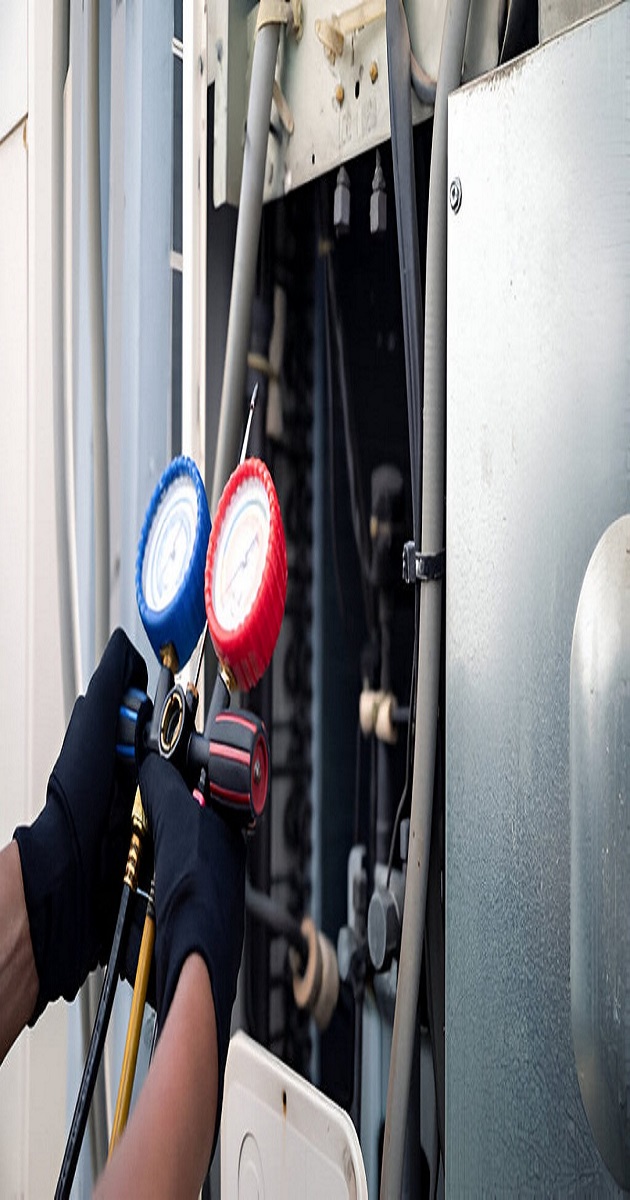
A meaningful AC service is not a filter rinse. For split and ducted systems, a thorough job includes:
- Evaporator and condenser coil cleaning using chemical agents to remove the grime and biological growth that accumulate in Dubai’s dust-heavy air
- Drain line flushing to prevent water leaks and mold growth in the condensate system
- Refrigerant pressure check and top-up if needed
- Electrical connection inspection for loose terminals or signs of overheating
- Thermostat calibration to ensure the unit cycles correctly rather than running continuously
Neglecting coils has a measurable cost. One documented case in Dubai Hills found a ducted system blowing 22°C air instead of the expected 14°C due to clogged coils; after a chemical wash, supply temperature dropped to 13.5°C and cooling capacity was restored. Customers who switch from cursory cleaning to proper servicing report DEWA bill reductions in the range of 15–30%, which often covers the cost of an AMC within a few months.
For ducted and central systems, annual duct cleaning is advisable given Dubai’s frequent sandstorms and high humidity, which promote dust accumulation and mold growth inside ductwork.
How to Choose a Provider Without Getting Burned
The Dubai AC market rewards a bit of skepticism. A few practical filters:
Check for diagnosis-first behavior. A provider that quotes a compressor replacement over the phone without inspecting the unit is either guessing or upselling. Reputable technicians diagnose before recommending parts. One reviewer described a case where a competitor quoted AED 3,200 for a compressor replacement; the actual fault was a failed capacitor, fixed on-site for AED 350.
Verify response times and emergency coverage. Dubai’s summer heat makes AC failure an urgent problem. Providers offering 24/7 emergency service with stated response windows (1–2 hours for AMC holders) are preferable to those who promise “same day” vaguely.
Ask about warranty on work and parts. A minimum 90-day guarantee on the service itself and a 3-month warranty on replaced parts is a reasonable baseline. Some providers offer longer terms—one lists a 90-day service guarantee and a 1-year warranty on repair work.
Read reviews for patterns, not just ratings. A 4.9-star average means little if the reviews are generic. Look for specific mentions of diagnostic accuracy, punctuality, and whether technicians explained what they found rather than simply presenting a bill.
The Bottom Line
For Dubai residents, the most cost-effective approach to AC care is straightforward: sign an AMC with a licensed provider before summer arrives, insist on coil and drain servicing rather than filter-only visits, and keep the contract active year-round rather than scrambling for emergency repairs in July. The upfront cost of a contract is almost always less than the combined cost of emergency callouts, inflated refrigerant charges, and the DEWA bills that come with neglected coils.
And when something does go wrong, the first question to ask a technician is not “how much to fix it” but “what did you find.” The answer will tell you whether you are dealing with a diagnostician or a parts-swapper.
